Morgan O. Smith
Author, Philosopher, Spiritual Teacher, A Lead Facilitator at Sacred Media's Integral Mastery Academy, Founder of Yinnergy Meditation/Neurofeedback, Bodhi Mental Care & Wellness, Co-founder of KeMor Centre for Innovative Development
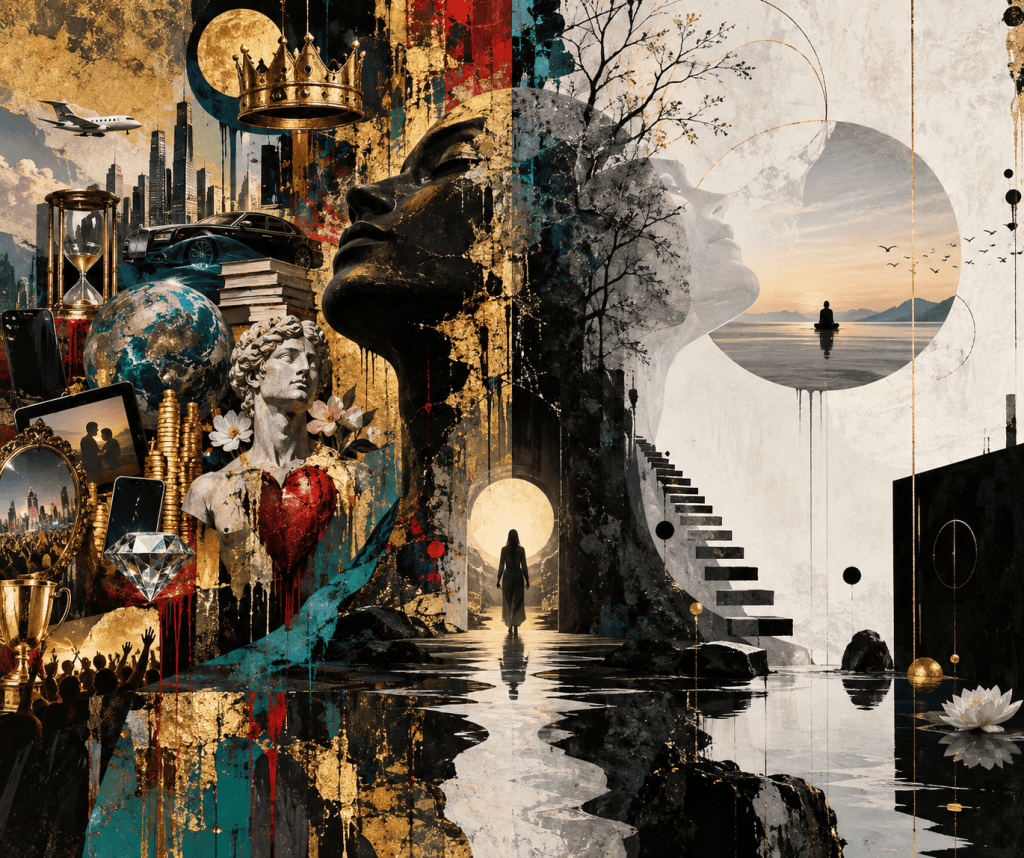
Worship your idols until your idols are no longer needed.
Another way to say this is:
Focus on your objectives until you’re forced to look within.
There is nothing inherently wrong with having idols.
There is nothing inherently wrong with ambition, achievement, recognition, wealth, status, influence, romance, physical beauty, intellectual mastery, spiritual attainment, or the desire to become extraordinary.
Sometimes the road beyond desire must first travel directly through it.
We often imagine spiritual maturity as the immediate rejection of worldly pursuits. Renounce the ego. Abandon ambition. Stop chasing things. Detach from outcomes. Transcend desire.
Yet premature renunciation can become another form of avoidance.
You can claim that money does not matter when you have never had any.
You can dismiss recognition when you secretly crave it.
You can condemn power because you have never experienced what it feels like to possess it.
You can declare yourself detached from relationships while quietly fearing intimacy.
You can criticize ambition while wondering whether you were capable of achieving what you wanted.
Sometimes you have to meet the idol before you can discover what it cannot give you.
An idol is anything onto which we project the promise of completion.
It might be a person.
A career.
A relationship.
A spiritual teacher.
A certain amount of money.
A perfect body.
A degree.
A mystical experience.
A following.
A business.
Enlightenment itself can become an idol.
The object changes, but the psychological movement remains remarkably similar:
When I obtain that, I will finally be complete.
This is what gives the idol its power.
The object itself may have value. Money can create freedom. Relationships can bring intimacy. Achievement can develop discipline. Knowledge can expand perspective. Meditation can transform how consciousness relates to experience.
The illusion begins when we ask something finite to provide what only the recognition of our fundamental nature can reveal.
We are not merely pursuing the object.
We are pursuing a feeling we believe the object will produce.
Freedom.
Security.
Love.
Wholeness.
Significance.
Peace.
The object becomes a symbol for an internal condition.
This is why getting what you want can sometimes be more spiritually disruptive than failing to get it.
Failure allows the fantasy to survive.
Success puts the fantasy on trial.
Suppose you spend twenty years believing that reaching a particular objective will finally make you happy.
Then you reach it.
For a while, there may be exhilaration. There should be. Something meaningful has happened.
But eventually ordinary consciousness returns.
You wake up as yourself.
The mind still moves.
Old insecurities may remain.
Fear still visits.
The body still ages.
Relationships still require work.
The applause fades.
Yesterday’s achievement becomes today’s normal.
Then an unsettling question appears:
Is this it?
That question can be more transformative than years of abstract spiritual philosophy.
You received what you asked life for, yet something remains unresolved.
The idol has fulfilled its purpose.
Not because it saved you, but because it failed to.
Its failure becomes instruction.
Certain desires disappear through understanding rather than suppression.
A child may desperately want a particular toy. Telling the child that the toy cannot provide lasting happiness will probably accomplish very little. The child needs the toy.
Then something fascinating happens.
The child gets it.
Plays with it.
Loves it.
Eventually puts it down.
What philosophy could not accomplish, experience did.
Adults are not fundamentally different.
Our toys become more sophisticated.
Titles.
Cars.
Followers.
Properties.
Credentials.
Partners.
Awards.
Spiritual experiences.
We give them adult names, but psychologically we may still be saying:
Maybe this will finally be enough.
There is wisdom in discovering for yourself what “enough” actually means.
This does not mean deliberately becoming materialistic or compulsively pursuing every desire that enters the mind. Some desires are destructive, and maturity includes discernment.
The deeper point is that genuine transcendence is different from repression.
Repression says:
I am not supposed to want this.
Transcendence says:
I understand what this can and cannot give me.
Those are radically different states of consciousness.
Spiritual seekers sometimes exchange socially acceptable idols for spiritually acceptable ones.
The pursuit of money becomes the pursuit of awakening.
Status becomes spiritual authority.
Achievement becomes attainment.
Possessions become experiences.
Comparison with coworkers becomes comparison with meditators.
Who has had kundalini awaken?
Who has experienced samadhi?
Who has reached jhana?
Who has dissolved the ego?
Who has seen God?
Who is enlightened?
The costume changes while the machinery of becoming continues operating underneath it.
The ego can pursue its own disappearance.
That is one of the great paradoxes of spiritual practice.
There may come a point when even enlightenment must be surrendered as an objective.
Not because awakening is meaningless, but because the imagined individual who intends to possess enlightenment may itself become the final idol.
You cannot own the Absolute.
You cannot place infinity on your spiritual résumé.
Pursue your objectives consciously.
Build something.
Learn.
Create.
Love.
Risk failure.
Develop your gifts.
Become excellent at something.
Explore what human life is capable of expressing.
But pay attention.
Notice what happens when you get what you wanted.
Notice how quickly the mind moves the finish line.
Notice when “I’ll be happy when…” quietly becomes another “when.”
Notice how every arrival eventually becomes another departure point.
The external journey gradually begins pointing somewhere unexpected.
Back toward the one who has been searching.
Who wants this?
What exactly am I hoping to receive from it?
What would happen if I obtained everything I wanted?
What remains when achievement, identity, status, belief, memory, personality and aspiration are temporarily set aside?
What is aware of all of this?
At some point the search changes direction.
You stop asking only:
What else can I acquire?
You begin asking:
Who is the one trying to become complete?
That question opens a very different door.
The mature relationship with an idol does not necessarily require destroying it.
You simply stop worshipping it.
Money can remain money.
Success can remain success.
A relationship can remain a relationship.
A teacher can remain a teacher.
Meditation can remain meditation.
Achievement can remain achievement.
They no longer carry the impossible responsibility of completing you.
You can enjoy them without confusing them with your Being.
You can participate without becoming psychologically imprisoned by participation.
You can succeed without needing success to tell you who you are.
You can fail without failure becoming a verdict on your existence.
Something profound changes when the world is no longer required to complete the one experiencing it.
Perhaps this is one meaning of freedom.
Not escaping the world.
Not rejecting desire.
Not pretending that objectives do not matter.
Rather, seeing their proper place.
Worship your idols if you must.
Study them.
Pursue them.
Stand before them.
Perhaps even achieve what they represent.
Then look carefully at what remains.
Eventually, the idol may cease to be an idol.
Not because someone convinced you that worship was foolish, but because experience revealed the limitation of what you were worshipping.
The objective did not betray you.
It brought you exactly where it was ultimately capable of bringing you.
To the edge of itself.
From there, there is only one direction left to look.
Within.
Morgan O. Smith
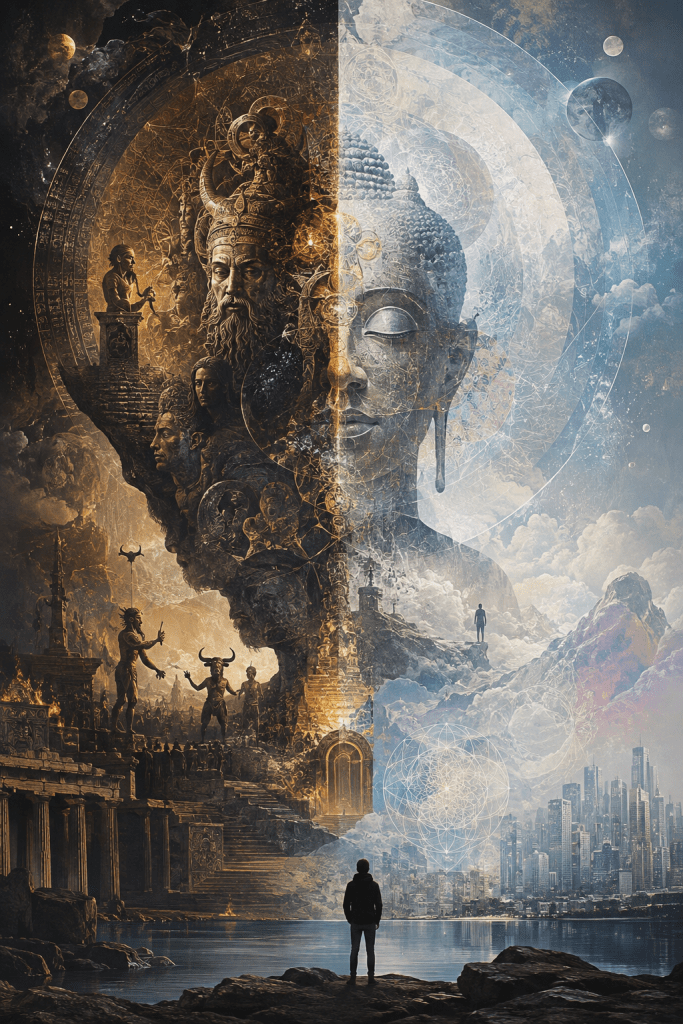
What if many of humanity’s earliest ideas about God reveal as much about the psychological development of human beings as they do about the Divine?
The archaic, magical, and mythical God did not simply appear from nowhere. These images of God emerged through human consciousness at particular stages of individual and collective development.
A God who demands obedience.
A God who rewards loyalty and punishes disobedience.
A God who belongs to one tribe and fights against another.
A God who controls storms, harvests, fertility, illness, victory, and defeat.
A God who must be pleased through sacrifice.
A God who watches human behaviour and keeps score.
A God who condemns outsiders while protecting the chosen.
These conceptions make considerably more sense when understood through developmental psychology.
Human beings interpret reality through the cognitive, emotional, moral, and cultural capacities available to them.
A child does not understand authority the same way an adult does. A tribal society does not necessarily conceptualize identity the same way a modern pluralistic society does. A consciousness organized primarily around survival, kinship, magical causation, or mythic belonging will naturally interpret ultimate reality through those structures.
God becomes understandable by becoming psychologically recognizable.
When human authority is organized around powerful chiefs and kings, God becomes the greatest King.
When social order depends upon obedience, God becomes the ultimate Lawgiver.
When tribal survival depends upon distinguishing “us” from “them,” God becomes our God rather than their God.
When natural events cannot yet be understood through scientific causation, thunder, drought, disease, eclipses, fertility, and catastrophe can become expressions of supernatural intention.
Human beings did not necessarily fabricate these experiences from nothing. Mystical experiences, altered states, dreams, intuitions, visions, awe, terror, transcendence, and encounters with the unknown may have been entirely genuine.
The interpretation of those experiences, however, passed through the developmental structures available to the person and culture experiencing them.
That distinction changes everything.
Someone can have an extraordinary experience while interpreting it through a relatively limited worldview.
This remains true today.
A profound state of consciousness does not automatically produce profound interpretation.
A person can experience ego dissolution and interpret it psychologically, neurologically, Buddhistly, Christianly, Vedantically, magically, or through some entirely personal cosmology.
The experience and the explanation are not identical.
Ancient humanity faced the same problem.
A genuine encounter with something overwhelming, boundless, numinous, or transpersonal could subsequently be translated into the language of spirits, gods, ancestors, demons, cosmic battles, divine commandments, or supernatural intervention.
The sacred encounter may have been profound.
The conceptual container could still have been developmentally limited.
Individual consciousness does not develop separately from culture.
Once a particular image of God becomes embedded within a community, that image can be reinforced through stories, rituals, institutions, authority structures, family systems, and social expectations.
Eventually, questioning the image of God becomes almost indistinguishable from questioning the community itself.
This is where developmental structures become collective structures.
The mythical God is no longer simply believed.
The mythical God organizes reality.
He determines morality, identity, belonging, sexuality, authority, social hierarchy, acceptable knowledge, and sometimes who deserves protection or punishment.
The collective then reproduces the developmental worldview that produced its God.
Children inherit it before possessing the cognitive capacity to examine it.
Adults defend it because their identity has formed around it.
Institutions preserve it because their authority may depend upon it.
What began as an interpretation of the sacred can eventually become an unquestionable description of reality.
This does not necessarily mean God evolves.
Our conception of God evolves.
That difference is crucial.
The Absolute may not become more sophisticated because human beings become more sophisticated.
Human beings become capable of recognizing dimensions of reality that previous structures of consciousness could not adequately conceptualize.
God as tribal protector can become God as universal Creator.
God as cosmic ruler can become God as unconditional Love.
God as separate supernatural Being can become Ground of Being.
God as object can dissolve into God as the very condition within which subject and object arise.
Eventually, even the word God begins to become problematic.
Advaita speaks of Brahman.
Mahayana Buddhism points toward emptiness.
Taoism warns that the Tao that can be named is not the eternal Tao.
Christian mystics speak of a God beyond concepts.
Apophatic traditions approach the Divine through negation, stripping away every description until nothing conceptual remains to grasp.
At sufficient depth, the question changes.
Instead of asking, “What kind of being is God?”
we begin asking,
“Why did we assume Ultimate Reality was a being at all?”
This may explain one of the great tensions between religion, atheism, mysticism, and developmental spirituality.
Modern rational consciousness examines the mythical God and finds contradictions.
Where is this supernatural ruler?
Why would an omnipotent being require worship?
Why would an infinite intelligence possess human emotions such as jealousy?
Why would the creator of billions of galaxies privilege one tribe, scripture, denomination, or historical period?
Why would eternal truth depend upon accepting propositions produced within a particular ancient culture?
These are powerful criticisms.
Yet atheism can sometimes reject the developmental representation of God while assuming it has rejected every possible meaning of the Divine.
The mystic makes a different move.
Rather than defending the old image, the mystic penetrates beneath it.
The question is no longer whether an invisible cosmic personality exists somewhere beyond the universe.
The inquiry becomes consciousness itself.
Being itself.
Existence itself.
Awareness itself.
Nothingness.
Infinity.
The mystery that remains when every concept has collapsed.
The famous claim that human beings created God in their own image may contain more truth than either believers or atheists usually recognize.
But the statement does not settle the question of Ultimate Reality.
It opens it.
Human beings may repeatedly construct images of the Divine according to their developmental capacity while something immeasurably deeper remains prior to every construction.
The mistake is not necessarily believing in God.
The mistake may be confusing our representation of God with whatever the word God is attempting to indicate.
A magical consciousness creates a magical God.
A mythical consciousness creates a mythical God.
A rational consciousness critiques that God.
A pluralistic consciousness discovers many Gods.
An integral consciousness begins recognizing the developmental structures producing all of these perspectives.
Mystical consciousness eventually encounters something stranger still:
Reality does not need our concepts.
The Absolute does not require mythology.
Brahman does not need to become an object of belief.
Perhaps spiritual maturation ultimately requires allowing our image of God to die repeatedly.
Not because there is nothing beyond it.
Because every God the mind can construct remains smaller than that which cannot be contained by mind.
And perhaps what humanity called God was never the old man above the clouds.
Perhaps that was simply as far as consciousness could see at the time.
Morgan O. Smith
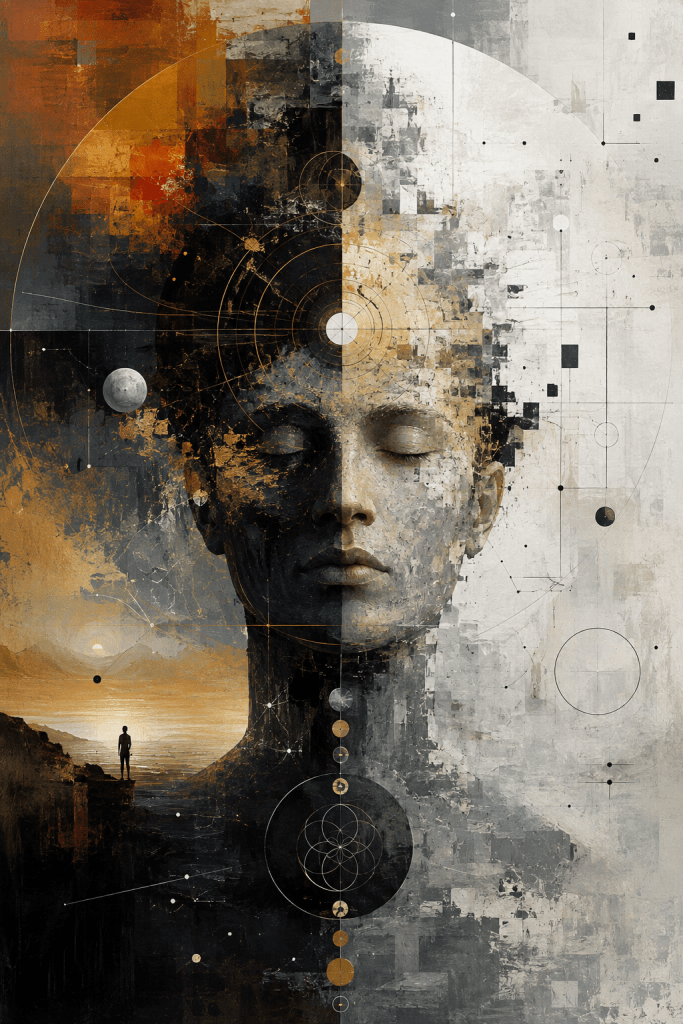
Few concepts in spirituality have been misunderstood as thoroughly as the ego.
We are repeatedly told to transcend the ego, destroy the ego, become egoless, or surrender the self. The implication is that spiritual maturity requires becoming less of a person, less defined, less assertive, and somehow psychologically smaller.
I see it differently.
A profound spiritual awakening does not require a weak ego. It may require an exceptionally developed one.
The problem is not that we have an ego. The problem is what the ego believes itself to be.
At its most basic level, the ego refers to the sense of self.
It is the psychological structure through which we organize experience around the perception of “I,” “me,” and “mine.” It allows us to establish boundaries, make decisions, assume responsibility, navigate relationships, pursue goals, withstand social pressure, and function as individuals within the world.
When someone says, “He has a big ego,” they are usually not talking about the existence of a strong sense of self. They are describing narcissism, defensiveness, arrogance, grandiosity, insecurity, or excessive self-importance.
Those are qualities that can characterize an ego.
They are not the definition of ego itself.
This distinction matters because spiritual communities sometimes confuse psychological weakness with spiritual transcendence.
A person can be passive, poorly differentiated, unable to establish boundaries, dependent upon approval, easily manipulated, and afraid of confrontation while imagining these characteristics to be signs of egolessness.
They may be nothing of the sort.
Sometimes what appears to be egolessness is simply an ego that has not sufficiently developed.
A healthy sense of self is necessary for functioning within a difficult world.
This becomes especially important for anyone carrying leadership, spiritual, community, social, or global responsibilities. Without sufficient psychological structure, other people’s expectations, projections, demands, criticisms, and agendas can overwhelm you.
The world can trample over a poorly developed self.
Meditation, when properly integrated, should not merely dissolve psychological structure. It can strengthen our capacity to remain centred while encountering stress, emotional activation, social pressure, uncertainty, and outside influence.
Paradoxically, spiritual practice can make the ego both stronger and more transparent.
Stronger does not necessarily mean louder.
It can mean more stable.
Less reactive.
Less easily manipulated.
Less dependent upon validation.
More capable of holding contradiction.
More capable of surrender.
This produces one of the great paradoxes of awakening:
The ego may need to become strong enough to let go of itself.
I make an important distinction between egoic death and ego death.
Egoic death refers to the collapse, surrender, or transformation of defensive ego structures. Identification with certain beliefs, roles, wounds, narratives, attachments, fears, and psychological defenses may loosen dramatically.
Something about “me” dies.
Yet the basic sense that there is still a “me” experiencing reality can remain.
Ego death, as I use the term, is more radical.
During a profound nondual awakening, the sense of being a separate subject can disappear altogether. There is no longer an individual standing apart from experience, observing reality from somewhere behind the eyes.
The subject-object structure collapses.
There is seeing, but no separate seer.
There is awareness, but no independently existing owner of awareness.
There is existence, but the familiar psychological centre claiming, “I am the one to whom existence is happening,” is absent.
That is what I mean by ego death.
The difference is enormous.
A person can undergo an extraordinary emotional, mystical, psychedelic, religious, or psychological transformation without experiencing the complete dissolution of the subject-object boundary.
Not every dramatic spiritual experience is a nondual awakening.
Not every loss of psychological defenses is ego death.
Permanent inability to function as a self is not the goal.
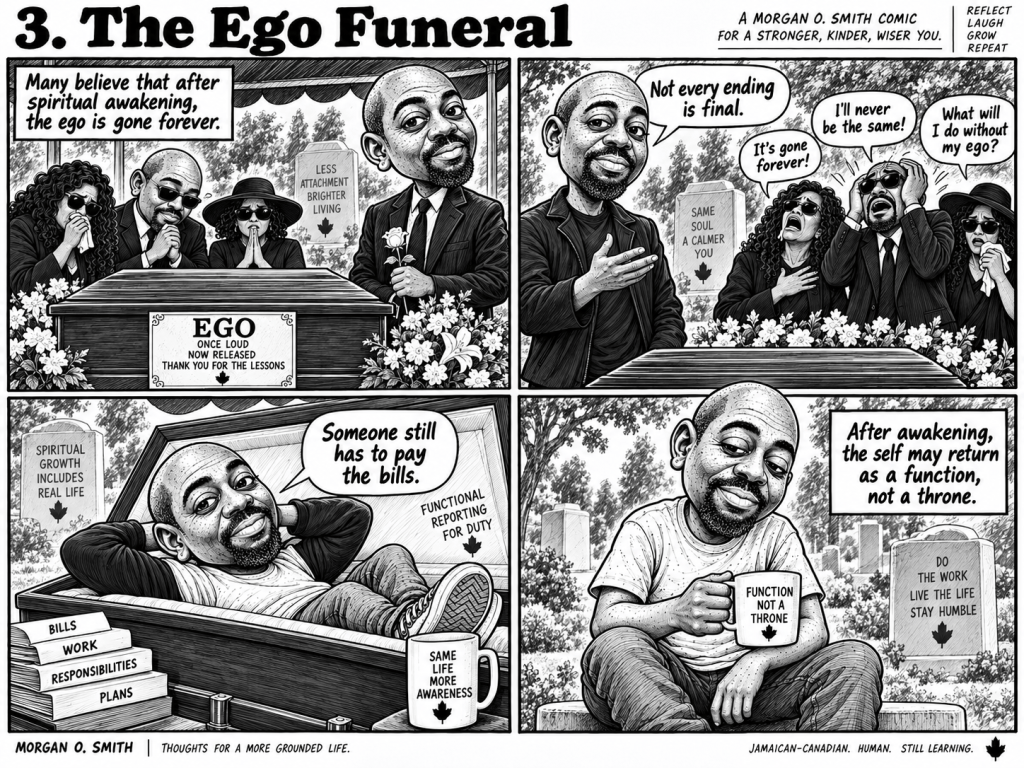
After a profound awakening, the practical personality returns because life requires it.
Your name returns.
Your responsibilities return.
Your relationships return.
Your preferences return.
Your history remains accessible.
Someone still has to answer the phone, pay the bills, make decisions, protect boundaries, honour commitments, create, teach, lead, and respond when another human being calls your name.
The ego resurrects itself as a functional structure.
But something can be fundamentally different.
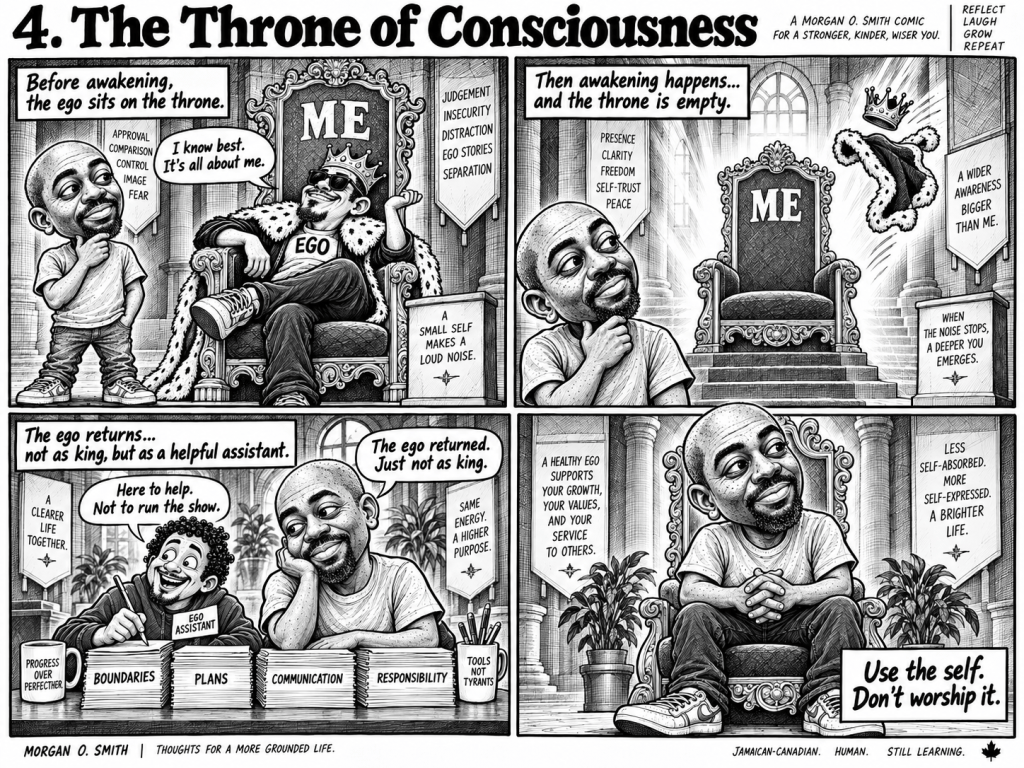
Before awakening, the ego can appear to be a solid psychological object at the centre of existence.
After awakening, it can become increasingly transparent.
The self still functions, but its apparent solidity has been penetrated.
You can use the self without completely mistaking yourself for it.
The ego returns, but it does not necessarily return to the throne.
This distinction is essential.
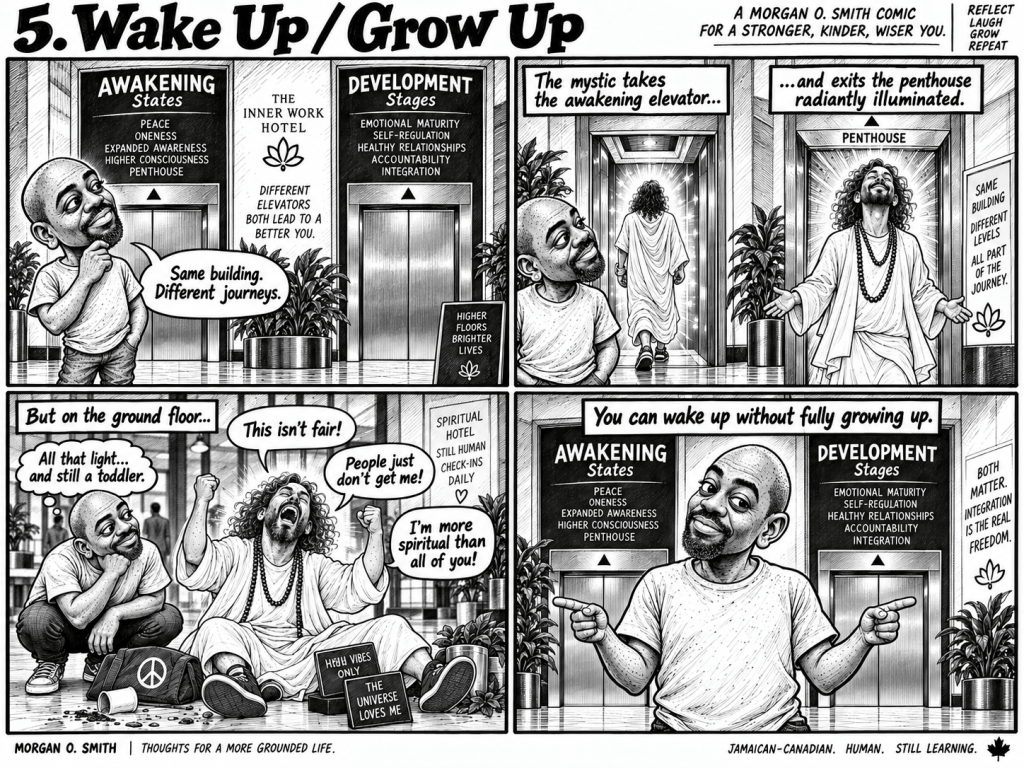
Psychological development and spiritual awakening are two different dimensions of a human being.
A person can have profound mystical states while remaining psychologically immature.
Another person can be extraordinarily mature, ethical, rational, compassionate, and psychologically integrated without ever experiencing nondual awakening.
Development does not automatically produce awakening.
Awakening does not automatically produce development.
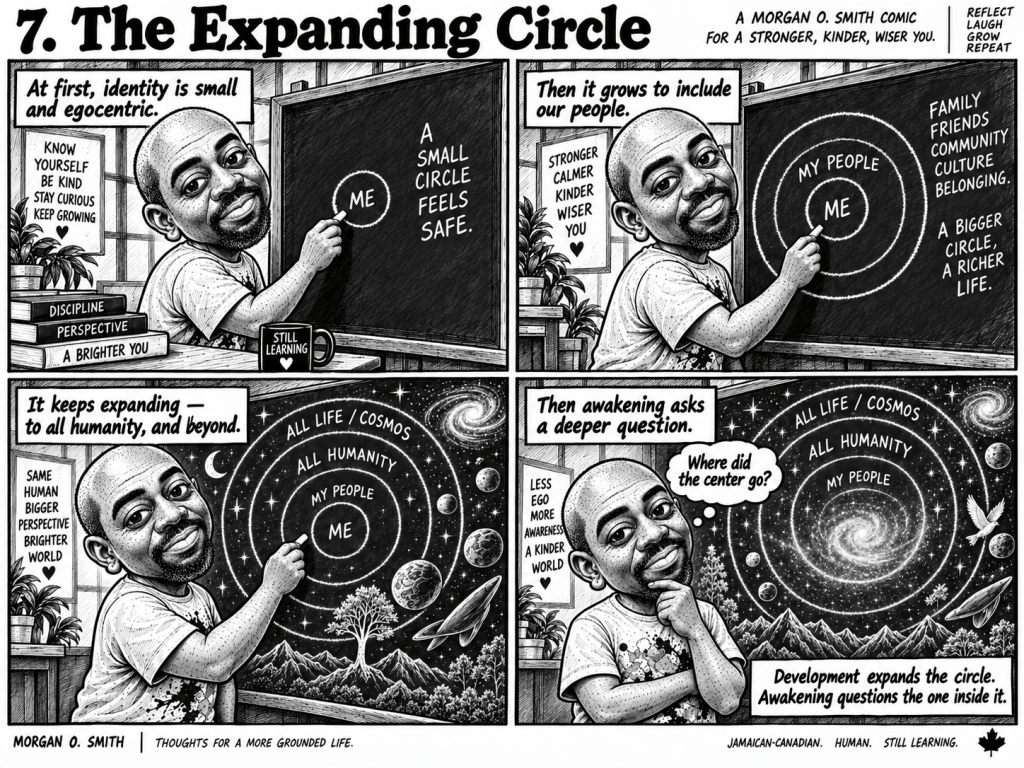
Psychological stages describe the increasing complexity and capacity of the ego.
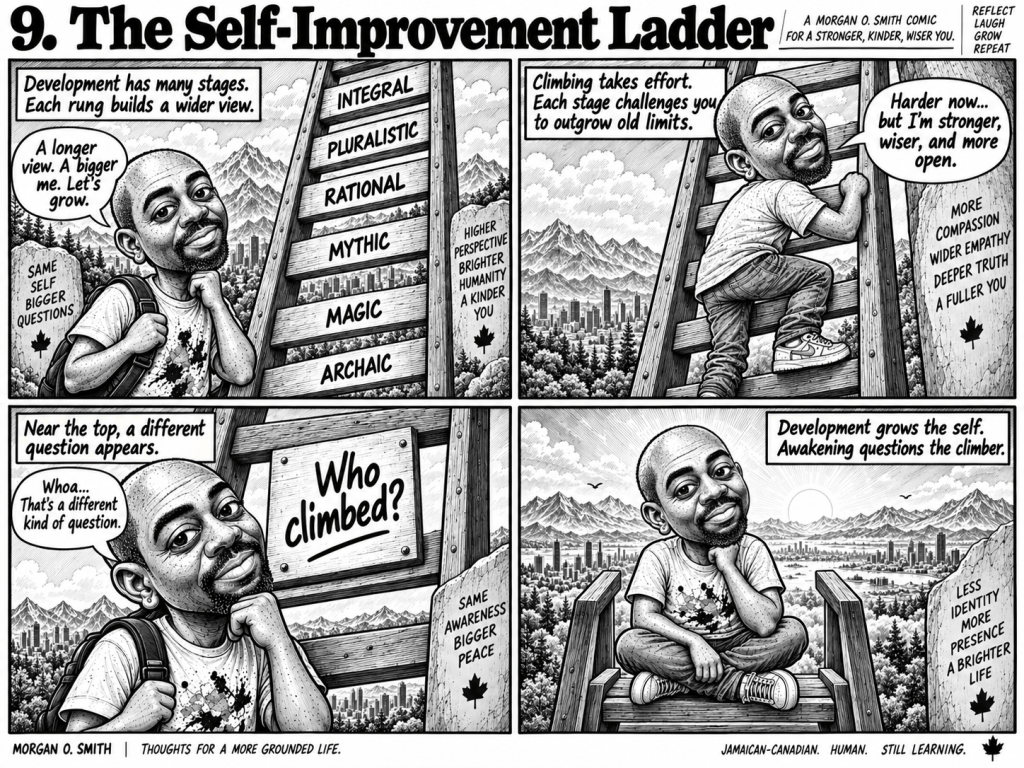
One developmental sequence can be described as:
Archaic → Magic → Mythic → Magic/Mythic → Rational → Pluralistic → Integral → Super-Integral
Each movement represents a transformation in how the self organizes reality, interprets experience, understands other people, constructs meaning, and relates to increasingly complex perspectives.
States of consciousness describe something different:
Waking → Dreaming → Dreamless Sleep → Turiya → Turiyatita
Turiya and turiyatita point toward dimensions associated with spiritual realization and enlightenment rather than merely greater psychological complexity.
Development asks:
How mature, complex, inclusive, and perspectivally capable is the self?
Awakening asks:
What is ultimately true about the self?
Those are not the same question.
This distinction explains something that otherwise seems contradictory.
How can someone have an authentic mystical awakening and still hold immature beliefs?
Because the state that was experienced and the psychological structure interpreting that state are not necessarily at the same level of development.
A person may enter an extraordinary state of consciousness and later interpret it through a Magic worldview.
Another may interpret a similar state Mythically.
Another Rationally.
Another Pluralistically.
Another Integrally.
The awakening may be profound while the interpretation of the awakening remains constrained by the developmental structure available to the person.
This is why spiritual experience alone does not automatically produce psychological maturity.
Someone can experience oneness and still be narcissistic.
Someone can experience emptiness and still lack healthy boundaries.
Someone can experience profound love and still hold ethnocentric beliefs.
Someone can experience the dissolution of the separate self and later reconstruct an identity around being “the awakened one.”
The ego is remarkably capable of claiming ownership of the experience in which its own separate existence temporarily disappeared.
That is one of the great ironies of spiritual awakening.
Another common misunderstanding is equating ego with egocentricity.
They are not synonymous.
Egocentricity describes a particular organization of identity in which one’s own needs, interests, desires, fears, and perspective dominate.
Development can progressively widen that identity:
Egocentric → Ethnocentric → Worldcentric → Kosmocentric
The egocentric self says:
I am primarily concerned with me.
The ethnocentric self expands:
I am one of us. My people, culture, religion, nation, group, or community matter.
The worldcentric self expands further:
My concern includes all human beings regardless of race, sex, class, nationality, culture, religion, creed, or social identity.
Kosmocentric identity expands beyond humanity:
My concern includes life, consciousness, the planet, the universe, and existence itself.
Something fascinating happens here.
From one perspective, the ego becomes smaller because self-centredness decreases.
From another perspective, the ego becomes enormous because what the person includes within the meaning of “self” has expanded dramatically.
The boundaries of identity become increasingly porous.
This is why calling a worldcentric or kosmocentric person “egoless” can be misleading.
They still require a functioning ego.
They still need boundaries.
They still need discernment.
They still need the ability to say yes and no.
They still need enough psychological strength to withstand manipulation, criticism, projection, conflict, responsibility, and pressure.
What has changed is the circumference of concern.
The self has expanded beyond its previous boundaries.
There is another paradox here.
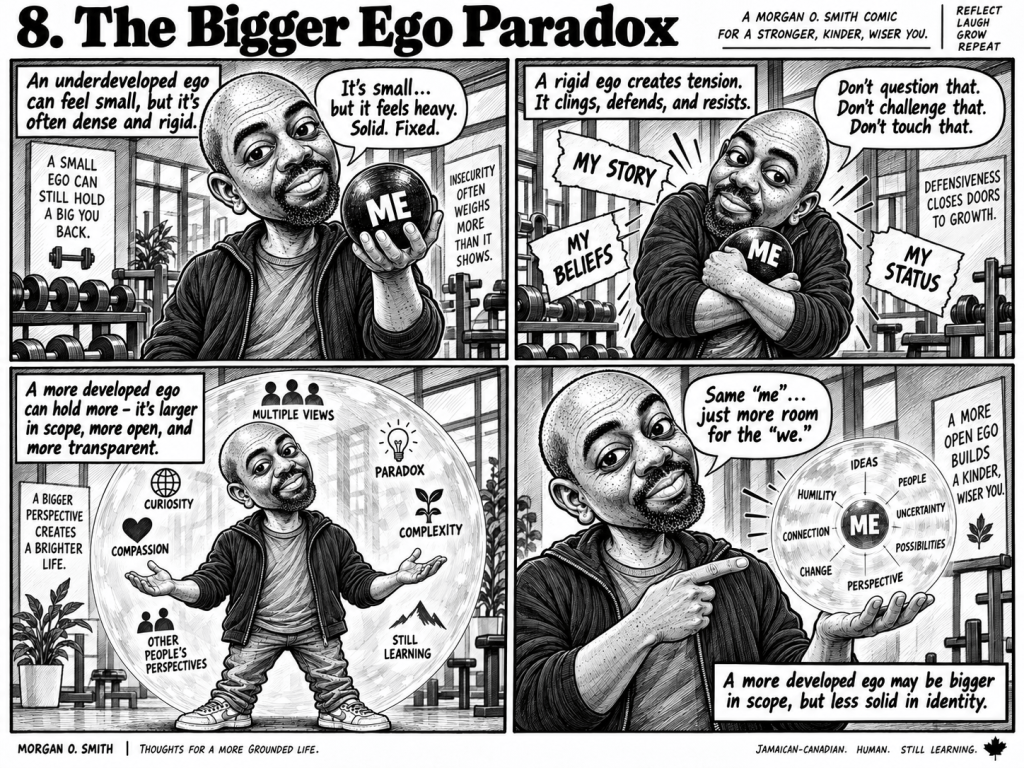
At lower levels of development, the ego can feel like a small but extremely solid object.
Everything revolves around protecting it.
My status.
My identity.
My beliefs.
My group.
My worldview.
My importance.
My security.
My story.
As development proceeds, the ego can become larger while simultaneously becoming less solid.
More perspectives can be included.
More contradictions can be tolerated.
More identities can be understood.
More complexity can be held without psychological collapse.
Eventually the ego becomes capable of questioning the very structure through which it has been interpreting reality.
This is where psychological development can become extraordinarily important for spiritual realization.
A highly developed ego may possess enough complexity to recognize the limitations of its own perspective.
The self becomes capable of seeing itself as a perspective rather than simply assuming that its perspective is reality itself.
That is a major shift.
Perhaps the highest development of ego is not an ego that dominates every room.
It is an ego capable of holding many rooms.
A highly developed person can recognize multiple perspectives without immediately collapsing them into their own.
They can understand why another person sees reality differently.
They can distinguish perspective from truth claims.
They can hold paradox without immediately demanding resolution.
They can examine their own assumptions.
They can move between subjective, interpersonal, cultural, systemic, spiritual, global, and kosmic perspectives.
They can possess strong boundaries without becoming rigid.
They can exercise authority without requiring superiority.
They can experience criticism without psychological collapse.
They can surrender without becoming submissive.
They can become transparent without becoming weak.
At increasingly integral and super-integral stages, the ego becomes capable of holding multiple perspectives simultaneously.
This is a very different picture of ego development from the stereotype of the dominant personality.
Perhaps the strongest ego is the one that no longer needs to constantly prove its strength.
This is where psychological development and spiritual awakening finally encounter one another.
Development progressively asks the ego to become larger, more complex, more inclusive, and more capable of perspective-taking.
Awakening eventually asks something completely different:
Who is this “I” that has been developing?
Development can take us from egocentric identity toward ethnocentric, worldcentric, and kosmocentric identity.
The circle becomes larger.
Awakening questions the centre of the circle itself.
Who is standing there?
Who is experiencing?
Who is aware?
Where exactly is the boundary between the observer and the observed?
At the highest psychological stages, the ego may become capable of seeing reality through multiple perspectives simultaneously.
At the deepest levels of awakening, something even more radical can be recognized.
The apparent observer is itself part of what is being observed.
From one nondual perspective, all existence is The Self.
From another, there is No Self anywhere to be found.
These statements appear contradictory only while we assume that Self must mean the individual personality.
The Self of nonduality is not the autobiographical self.
It is not the personality.
It is not your name, history, occupation, nationality, race, sex, religion, ideology, accomplishments, wounds, preferences, or social identity.
The startling recognition is that what you ultimately are cannot be contained within the psychological structure you previously called yourself.
Advaita can express this realization as Self.
Buddhist traditions may approach it through emptiness and no-self.
The language differs.
The ordinary assumption of an independently existing psychological subject is being challenged at its root.
There is an intriguing convergence between the highest reaches of development and the deepest reaches of awakening.
Development expands identity.
Awakening dissolves the assumption that identity possesses an independently existing centre.
At first:
I am me.
Then:
I am one of us.
Then:
All human beings are within my circle of concern.
Then:
Life, consciousness, the planet, and the cosmos are within my circle of concern.
Nondual awakening can take the inquiry somewhere even stranger:
Where is the boundary separating “me” from existence in the first place?
From the perspective of Self, everything is Myself.
From the perspective of no-self, there is no separate “myself” anywhere.
Absolute inclusion and absolute emptiness begin pointing toward the same mystery from opposite directions.
The ego cannot manufacture this realization simply by becoming more psychologically developed.
But a developed ego may be far better equipped to integrate what happens when its assumed centrality collapses.
This may be one of the most important cautions in serious spiritual work.
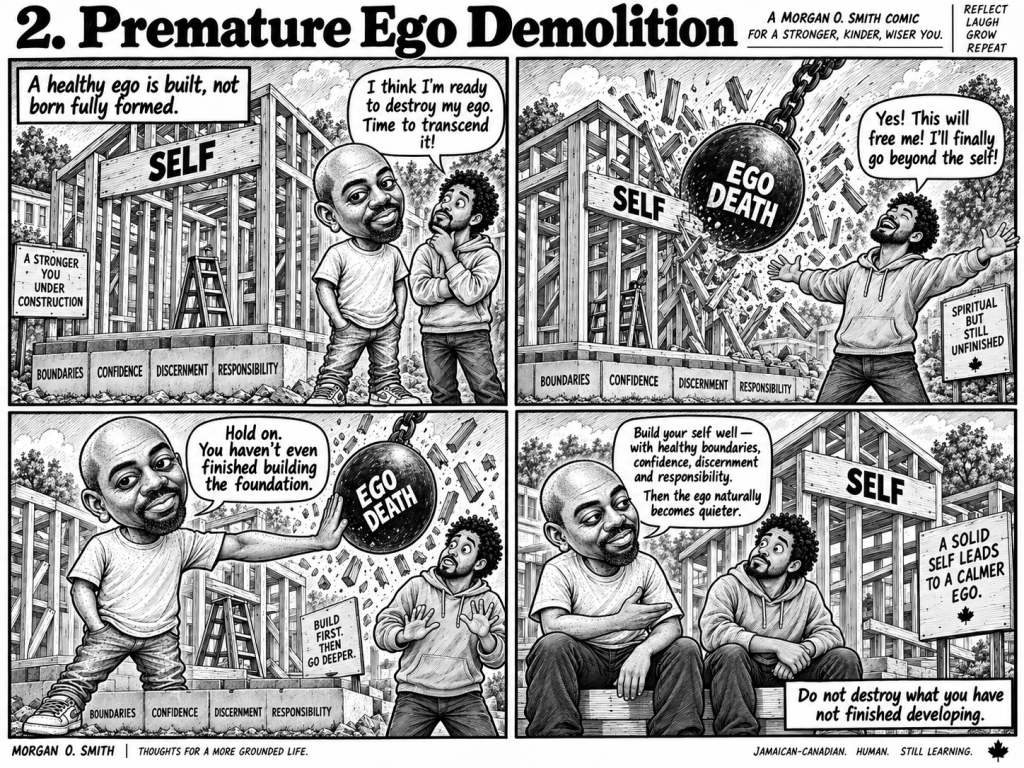
Trying to destroy the ego prematurely can become another form of avoidance.
Someone who needs boundaries may try to become egoless.
Someone who needs confidence may practice self-erasure.
Someone who needs psychological integration may pursue transcendence.
Someone who needs to learn how to say no may interpret surrender as saying yes to everyone.
Someone who needs a coherent identity may attempt to dissolve identity altogether.
Someone who needs to develop personal agency may mistake passivity for spiritual surrender.
This can become especially dangerous around spiritual authority.
A poorly developed sense of self may make someone highly susceptible to manipulation while they interpret their inability to resist authority as humility.
That is not necessarily transcendence.
Spiritual awakening should not require becoming incapable of being human.
The work is subtler than that.
Develop the self.
Strengthen it.
Integrate it.
Expand it.
See through it.
Let it become transparent.
And when consciousness finally discovers what exists prior to the distinction between self and other, allow the ego to surrender completely.
Then let it return.
Not necessarily as the ruler of consciousness, but as one of its instruments.
Psychological stages of development and states of awakening are two different facets of every individual.
One concerns the development of the self.
The other concerns awakening beyond the assumed limitations of that self.
One can grow horizontally and vertically through increasingly complex structures of identity, morality, cognition, perspective, and concern.
One can also awaken into increasingly profound states in which the ordinary construction of self and reality becomes transparent or disappears altogether.
Neither dimension should be mistaken for the other.
A sophisticated worldview does not prove enlightenment.
A profound mystical experience does not prove psychological maturity.
The extraordinary possibility is the development of both.
A human being can become psychologically strong without becoming psychologically rigid.
Deeply individual without becoming egocentric.
Worldcentric without losing personal boundaries.
Kosmocentric without abandoning practical responsibilities.
Capable of inhabiting multiple perspectives without losing discernment.
And spiritually awakened without becoming psychologically diminished.
Perhaps the mature spiritual question is therefore no longer:
“How do I get rid of my ego?”
A more interesting question is:
How fully can the self develop before it discovers that it was never the whole of what I am?
Beyond even that lies a question no psychological stage can answer for us:
When the sense of being a separate self disappears completely, what remains?
Morgan O. Smith
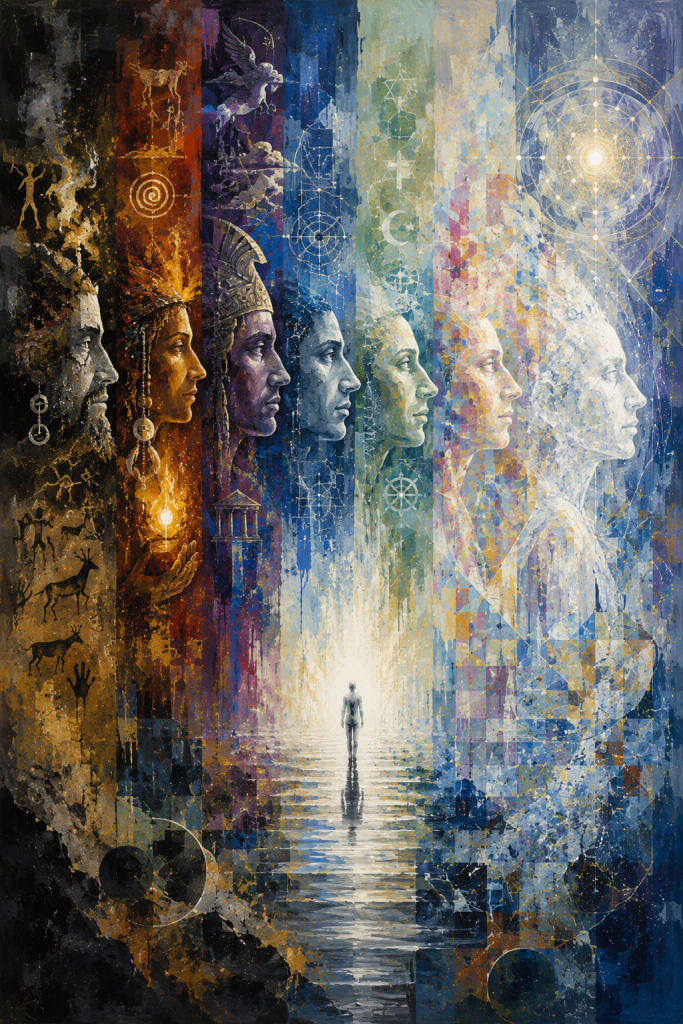
Which God Do You Believe In?
When people argue about God, they often assume they are speaking about the same reality. Yet many disagreements arise because each person is referring to an entirely different understanding of God, one shaped by their own stage of psychological, cultural, and spiritual development.
Our concept of God often evolves as our own consciousness evolves.
An archaic understanding of God is rooted in survival. The divine is experienced as mysterious, unpredictable, and inseparable from the raw forces of nature. Fear and awe become the primary forms of worship because existence itself feels fragile.
A magical understanding sees God actively intervening in everyday events. Blessings, curses, rituals, omens, and supernatural signs become central. The world feels enchanted, and divine power appears to operate through symbolic acts and sacred objects.
A mythical understanding presents God through sacred stories, unquestionable doctrines, and absolute moral laws. Faithfulness often means loyalty to one’s tradition, while competing beliefs are viewed with suspicion or rejection.
A rational understanding asks difficult questions. Science, philosophy, evidence, and critical thinking become important. God may still exist, but beliefs are expected to withstand intellectual scrutiny rather than rely solely on tradition or revelation.
A pluralistic understanding recognizes wisdom across many religions and philosophies. Rather than insisting that one path possesses the whole truth, it appreciates the possibility that different traditions illuminate different aspects of the same mystery.
An integral understanding attempts to include every previous perspective without dismissing them. Each view is understood as expressing something meaningful within its own context. The question shifts from “Which one is right?” to “What truth is each perspective trying to reveal?”
A super integral understanding goes even further. God is no longer merely an object of belief or a concept to defend. The distinction between God, self, and reality begins to dissolve. Divinity is not encountered as something separate from experience. It is recognized as the very ground from which all experience arises. Every stage, every worldview, every certainty, and every doubt appears as an expression of the same limitless reality.
This progression does not suggest that one stage is morally superior to another or that everyone must follow the same sequence. Human development is complex, and people often embody several perspectives simultaneously depending on the circumstances.
The more interesting question is not whether God exists.
The more revealing question is this.
Which version of God are we talking about?
Our answer may reveal far more about the structure of our own consciousness than about God.
Perhaps the deepest spiritual maturity arrives when we no longer need God to conform to our ideas. Instead, we allow our ideas to dissolve into the mystery they were always pointing toward.
Morgan O. Smith
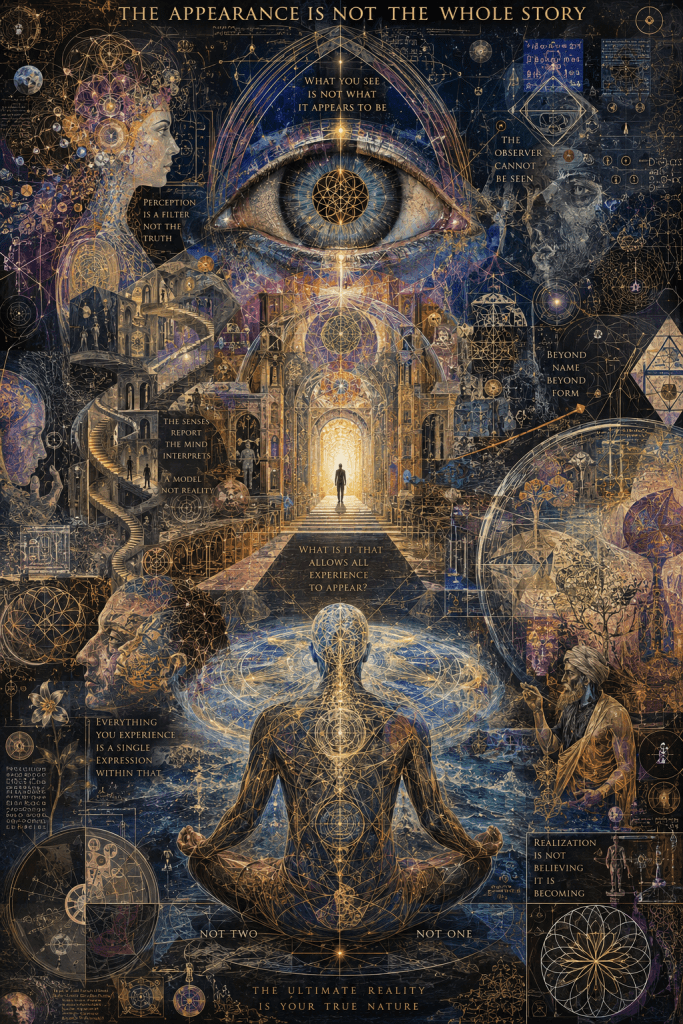
Some of you believe I am delusional or disconnected from reality because of the way I speak about consciousness. That conclusion makes sense if you assume I am denying the world you experience every day. I am not.
I am not saying that what you see, hear, smell, taste, touch, or feel internally is unreal. Those experiences undeniably occur. They shape your life, your relationships, your joys, and your suffering.
My point is something altogether different.
The mistake is assuming that experience is exactly what it appears to be.
Throughout history, humanity has repeatedly mistaken appearances for reality. The sun seemed to circle the Earth. Matter appeared solid and indivisible. Time felt absolute. Careful investigation revealed that each of these assumptions concealed a deeper truth.
Perhaps consciousness deserves the same level of investigation.
Ask yourself a simple question. What is it that allows every experience to appear at all?
Before you answer with the brain, the mind, or the senses, examine the question carefully. Those are themselves experiences. They are objects that appear within awareness. What is it that knows them?
That is the mystery worth solving.
No one can solve it for you.
I can tell you what I have realized, but my words are not your realization. Concepts may point, but they cannot replace direct recognition. Borrowed certainty only delays genuine discovery.
Many traditions have given this ultimate reality different names. God. Brahman. Allah. Source. Spirit. The Ground of Being. Each points toward something beyond language. Names are useful for conversation, but they are never the thing itself.
The destination cannot be captured by a label.
When this becomes more than an intellectual idea, something remarkable happens. The world does not disappear. Your senses continue to function. You still see, hear, smell, taste, touch, think, and feel.
What changes is your relationship to experience.
The world is no longer mistaken for the whole of reality. Every sight, every sound, every emotion, every thought becomes a single expression within something immeasurably greater.
The person you believed yourself to be also takes its proper place. Instead of standing apart from reality, it is recognized as one movement within it.
Nothing needs to be rejected.
Nothing needs to be escaped.
Only the assumption that appearances tell the whole story is questioned.
That investigation is not about adopting my conclusions or anyone else’s. It is about looking deeply enough that the answer reveals itself.
When it does, you may discover that what you have been searching for has never been absent.
Morgan O. Smith
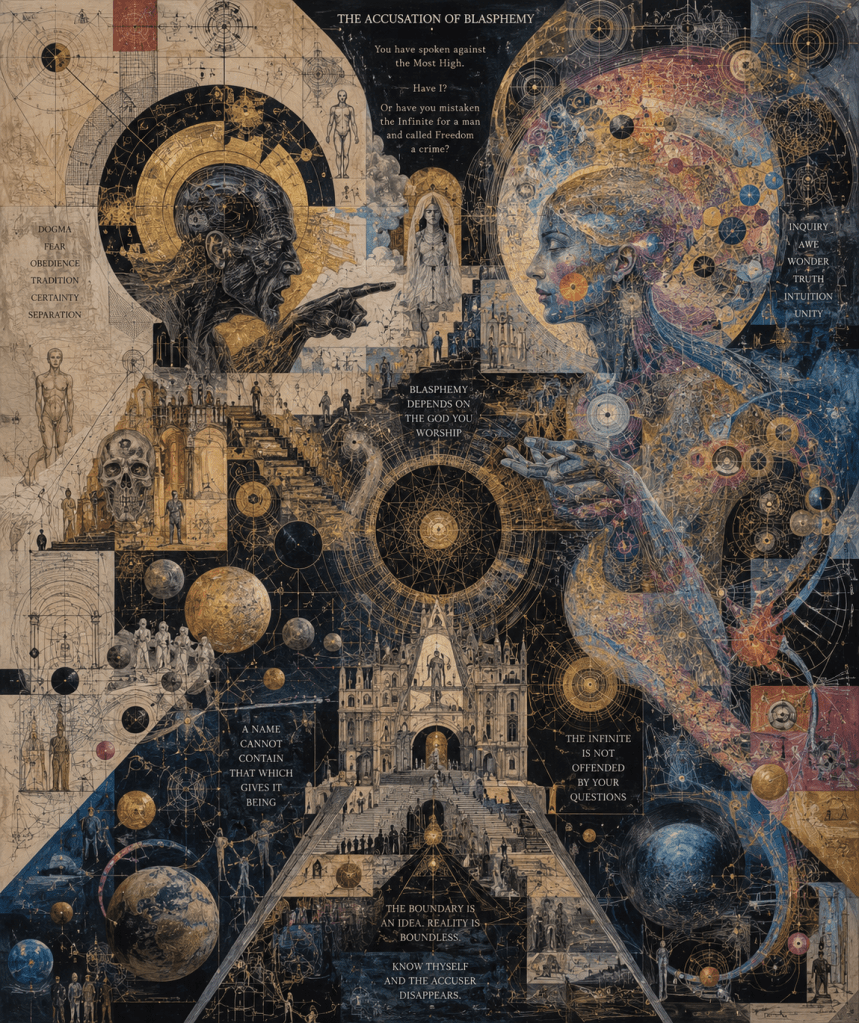
Many of you have called me a blasphemer. If your understanding of God is built upon a supernatural being who exists somewhere beyond the universe, then I understand why you would arrive at that conclusion.
From that perspective, questioning sacred beliefs is an offense. Challenging religious certainty becomes rebellion. Refusing to bow before inherited ideas appears arrogant or dangerous.
I understand the reaction.
My position changes completely once the word God points to something fundamentally different.
Suppose God is not a person with preferences, opinions, or emotions. Suppose God is not a cosmic ruler who rewards belief and punishes doubt. Suppose God is the infinite reality from which every experience, every atom, every thought, every galaxy, and every conscious being arises.
What, then, could blasphemy possibly mean?
Can a wave insult the ocean?
Can space offend itself?
Can existence commit a crime against existence?
The charge of blasphemy assumes separation. It assumes there is a believer over here, a divine authority over there, and a boundary between the two that can be violated.
Direct realization dissolves that boundary.
This is not an invitation to disrespect religious traditions. Many traditions contain extraordinary wisdom. Their symbols, rituals, and stories have guided countless people toward compassion, humility, and profound insight.
The difficulty begins when symbols are mistaken for literal reality.
History shows that nearly every major breakthrough has been labeled dangerous by those invested in preserving the familiar. Scientific discoveries, philosophical revolutions, and spiritual insights have often been condemned before they were understood.
Perhaps the same pattern appears in discussions about God.
If God is truly infinite, then every sincere investigation into reality is already taking place within God. Honest questioning cannot threaten what is absolute. Curiosity cannot diminish infinity. Truth has nothing to fear from examination.
Perhaps what people call blasphemy is sometimes only the sound of certainty encountering a perspective it has never considered.
The greatest obstacle may not be disbelief.
It may be believing we already know what the word God refers to.
Morgan O. Smith
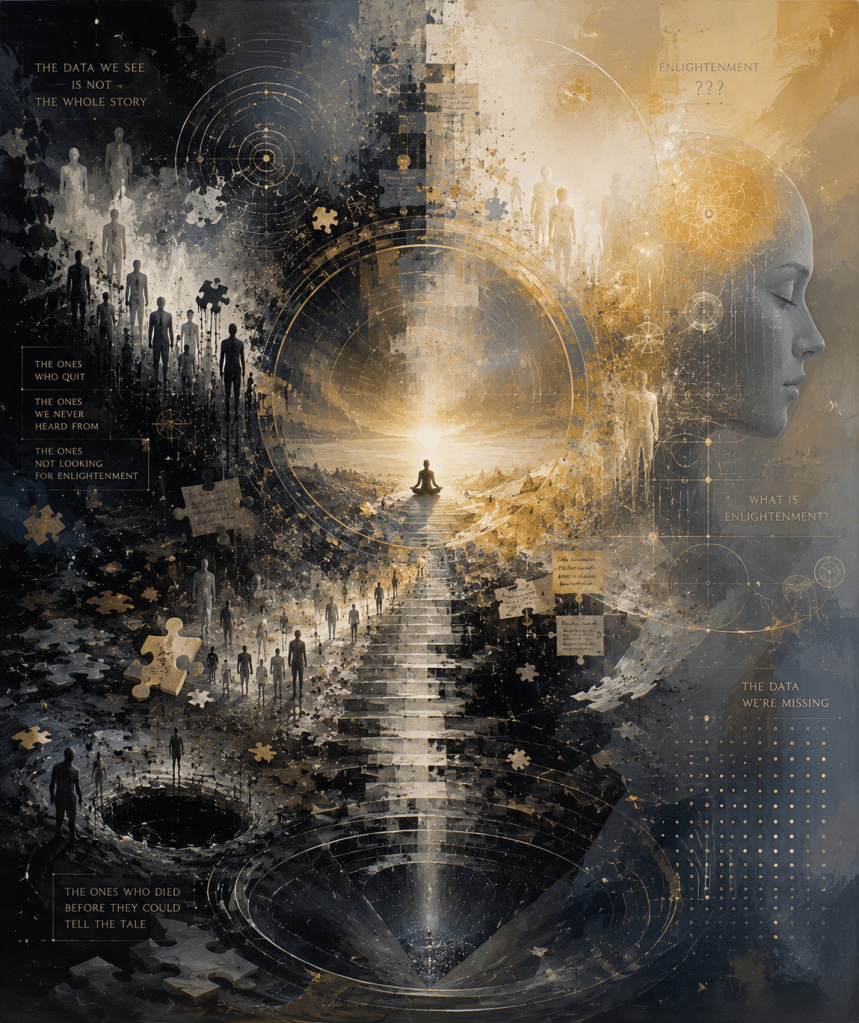
Looking at the issue rationally, however, reveals a far more complicated picture.
Some people making these claims are undoubtedly mistaken. Others may be describing something genuine, yet only from the perspective of a single life. Personal realization, no matter how profound, is still a sample size of one. Direct experience carries immense value, but it does not automatically reveal the complete mechanism behind the experience.
Every few years, someone claims to have uncovered the science of spiritual enlightenment. Some speak from decades of disciplined practice. Others present neuroscience, psychology, or contemplative research as evidence. I have made similar claims myself, based on my own direct experience.
Another complication lies in language. Not everyone who undergoes a profound shift calls it enlightenment. Some describe it as psychological freedom, ego dissolution, awakening, union with God, self-realization, mystical consciousness, or simply becoming fully present. Others never place a label on it at all. Entire populations may have experienced comparable transformations while using completely different conceptual frameworks.
Bias enters the conversation from every direction. Traditions often assume their own methods are uniquely effective while dismissing others. Skeptics sometimes reject extraordinary claims before examining the evidence. Devotees may accept them without sufficient scrutiny. Researchers may overlook valuable observations because they originate outside established academic institutions. Teachers may overestimate the universality of their own path because it worked for them.
Perhaps the largest blind spot receives surprisingly little attention.
Survivorship bias.
We primarily hear from those who report success.
They successfully write books. They appear on podcasts. They teach retreats, facilitate workshops, and attract students eager to follow their path. Their stories become the data set from which future seekers attempt to reverse engineer enlightenment.
Far less attention is given to everyone else.
What about those who devoted twenty years to meditation without reaching the destination they sought?
What about practitioners who quietly concluded the pursuit was not for them?
What about individuals whose lives improved significantly through practice but who never considered themselves enlightened?
What about those whose deepest realization occurred privately, with no desire to teach or publish?
What about those whose greatest insight arose during the final moments of biological life, leaving no opportunity to communicate what they discovered?
These voices rarely become part of the conversation.
Without them, our understanding may be fundamentally incomplete.
Imagine trying to understand the science of becoming an Olympic athlete by interviewing only gold medalists. Their insights would be invaluable, yet thousands of equally dedicated athletes who trained just as hard but fell short would possess information that is every bit as important. Their experiences might reveal overlooked variables, hidden obstacles, ineffective assumptions, or simply the role of chance.
The search for enlightenment may suffer from the same limitation.
If every authentic teacher described exactly how awakening unfolded, we would still be missing the experiences of everyone who practiced with equal sincerity but arrived somewhere else. That absence distorts the picture.
Adding another layer of complexity, we have yet to reach universal agreement on what enlightenment actually is. Is it permanent nondual awareness? Freedom from psychological suffering? Stable witness consciousness? Complete ego transcendence? Union with God? A measurable neurological state? Or are these different expressions of a broader phenomenon?
Without a shared definition, comparing outcomes becomes extraordinarily difficult.
Some scientists argue that the mystery has already been solved through neuroscience, predictive processing, or cognitive models of consciousness. Others remain unconvinced, pointing out that many proposed explanations have yet to withstand broad scientific scrutiny. The debate continues because the available evidence remains incomplete.
Personally, I know several people who have undergone profound spiritual awakenings. Their lives changed in unmistakable ways. Yet I know even more people who abandoned the search altogether, or whose goals were never enlightenment in the first place. Most of them will never write a memoir or appear in a documentary. Their experiences remain invisible.
Ironically, those invisible experiences may hold some of the most valuable clues.
Perhaps solving the mystery of enlightenment requires more than studying those who claim to have arrived. Perhaps it requires listening just as carefully to those who did not, those who stopped searching, those who never used spiritual language, and those whose stories were never recorded.
The greatest breakthrough may not come from discovering another enlightened teacher.
It may come from finally paying attention to everyone we forgot to ask.
Morgan O. Smith


 Morgan O. Smith